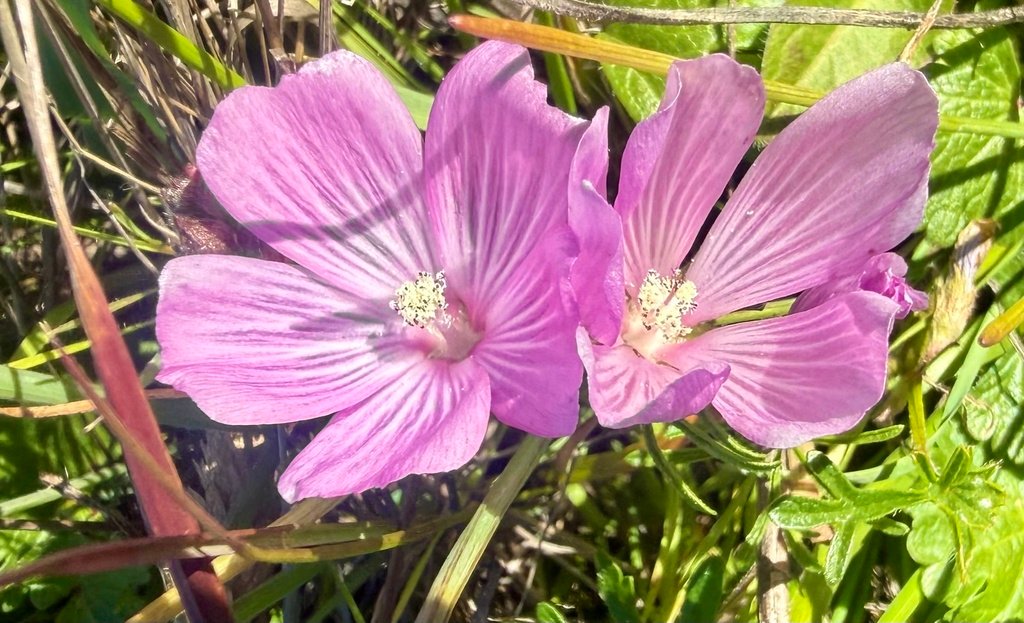
Sidalcea asprella
Greek Mallow
Sidalcea malviflora
(DC.) A.Gray Species


- Botanical name
- Sidalcea malviflora
- Also known as
- Checker-Mallow, Checkerbloom, Greek Mallow, Greek-Mallow
- Family
- Malvaceae
- Genus
- Sidalcea
- Flowering period
- June to August
- Height
- 60–100 cm
- Spread
- 30–45 cm
- Hardiness
- Fully hardy (RHS H6)
- Reference
- World Flora Online
How to grow Greek Mallow
Full sun
Moderate; water in dry spells
Fertile, moisture-retentive but well-drained
Neutral to slightly acid
Planting
Plant in autumn or spring in an open sunny border in soil that holds some moisture through summer. It is upright and narrow rather than bushy, so plant in threes or fives for any real effect.
Pruning
Cut the flowered stems back to the basal foliage as soon as the spikes fade; this frequently produces a second flush in early autumn. Cut down to the ground in late autumn.
Propagation
Divide in spring every few years, which also keeps the plant vigorous. Seed is available and germinates reasonably, though seedlings vary in colour.
Pests and diseases
Hollyhock rust affects it, showing as orange pustules on the undersides of the leaves; remove and dispose of affected foliage rather than composting it. Slugs take spring growth.
Value to wildlife
The small mallow-like flowers up the spike are worked by bees over a long midsummer period.
Notes
The slim spikes flop in exposed positions and after heavy rain, so support them early. Clumps decline after three or four years without division.
This guidance was researched and written by GardenDecoded — see our editorial policy for how guides are checked and reviewed.
Other names for this plant
These names have all been used for Sidalcea malviflora but are no longer the accepted name. You may still meet them on old labels, in books, or in nursery catalogues.
Nuttallia malviflora
Sida delphiniifolia
Sida malviflora
Sidalcea malviflora subsp. malviflora
Others in Sidalcea
GardenDecoded is an educational gardening reference. Botanical data comes from World Flora Online and GBIF; growing guidance is our own. Always check a plant's toxicity and local invasiveness status before planting, and never eat or apply a plant based on this site alone.