Parthenocissus heptaphylla
American Ivy
Parthenocissus quinquefolia
(L.) Planch. Species


- Botanical name
- Parthenocissus quinquefolia
- Also known as
- American Ivy, American-Ivy, Five-Leaf-Ivy, Five-Leaved Ivy, Fiveleaved Ivy, Virginia Creeper, Virginia-Creeper, Woodbine
- Family
- Vitaceae
- Genus
- Parthenocissus
- Flowering period
- May
- Height
- 8–15 m
- Spread
- 3–8 m
- Hardiness
- Fully hardy (RHS H6)
- Reference
- World Flora Online
How to grow American Ivy
Full sun to partial shade
Moderate while establishing; low once settled
Any reasonable well-drained garden soil
Acid, neutral or alkaline
Planting
Plant in autumn or spring about 30–45 cm out from the wall, angling the stems inwards and watering well in the first season. It climbs by adhesive pads and needs no wires or trellis. Give it a very large, sound wall — this is not a plant for a small courtyard.
Pruning
Cut back in winter, hard if needed, keeping it clear of gutters, windows and roof edges where it will otherwise lift tiles. It tolerates severe pruning and regrows quickly. Expect to do this every year once it is established.
Propagation
Semi-ripe cuttings in summer or hardwood cuttings in winter both root readily. Layering a low stem is even simpler.
Pests and diseases
Largely trouble-free. Occasional leaf spot or powdery mildew appears in poor summers but does not need treating.
Value to wildlife
The blue-black berries are taken by birds in autumn, and the dense leaf cover shelters nesting birds and invertebrates.
Notes
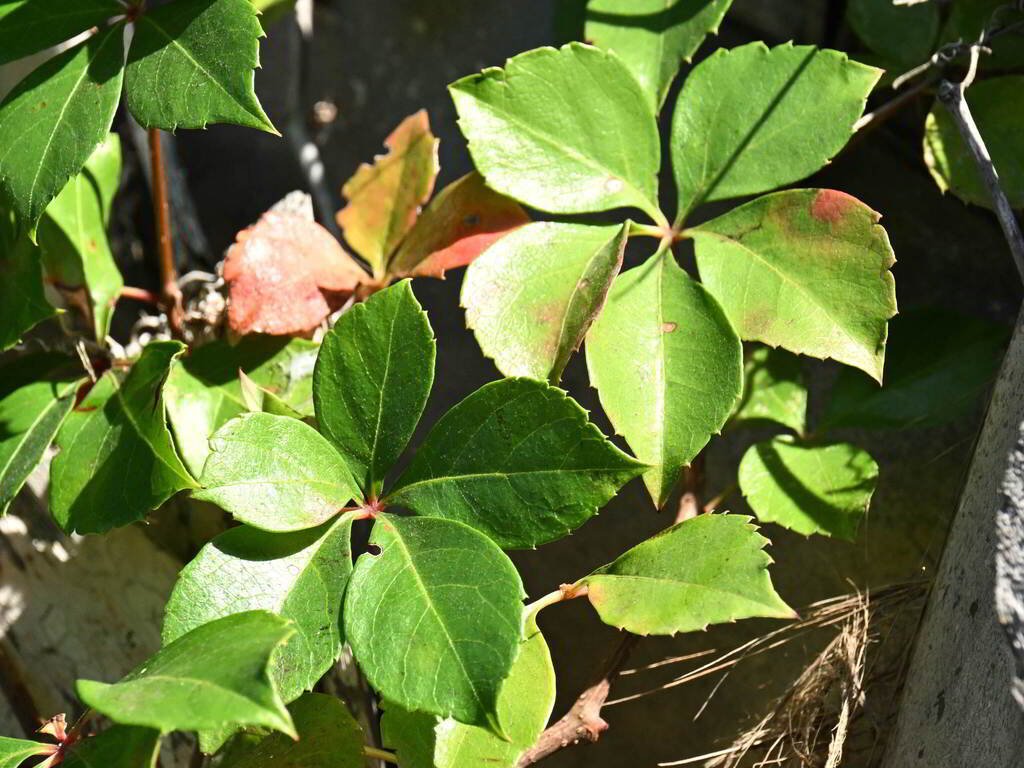
Grown almost entirely for the scarlet and crimson autumn colour, which is strongest in an open sunny position. The adhesive pads leave marks on paintwork and can pull away weak render, so keep it to sound brick or stone. It self-seeds where birds drop the berries.
Some structured details on this page (such as tolerances, pH and hardiness) come from USDA PLANTS Database (public domain). The written guidance is GardenDecoded's own, researched as described in our editorial policy.
Other names for this plant
These names have all been used for Parthenocissus quinquefolia but are no longer the accepted name. You may still meet them on old labels, in books, or in nursery catalogues.
Ampelocissus cirrhata
Ampelocissus major
Ampelocissus serrata
Ampelocissus tricolor
Ampelopsis engelmannii
Ampelopsis graebneri
Ampelopsis hederacea
Ampelopsis hederacea var. dumetorum
Ampelopsis hederacea var. minor
Ampelopsis hederacea var. murorum
Ampelopsis himalayana
Ampelopsis hirsuta
Ampelopsis latifolia
Ampelopsis muralis
Ampelopsis pubescens
Ampelopsis quinquefolia
Ampelopsis quinquefolia var. angustifolia
Ampelopsis quinquefolia var. dumetorum
Ampelopsis quinquefolia var. graebneri
Ampelopsis quinquefolia var. heptaphylla
Ampelopsis quinquefolia var. hirsuta
Ampelopsis quinquefolia var. laciniata
Ampelopsis quinquefolia var. latifolia
Ampelopsis quinquefolia var. murorum
Ampelopsis quinquefolia var. pubescens
Ampelopsis quinquefolia var. radicantissima
Ampelopsis quinquefolia var. spaethii
Ampelopsis radicantissima
Ampelopsis radicantissima f. minor
Ampelopsis radicantissima var. engelmannii
Ampelopsis radicantissima var. graebneri
Ampelopsis radicantissima var. saint-paulii
Ampelopsis roylei
Ampelopsis saint-paulii
Ampelopsis saint-paulii
Ampelopsis virginiana
Ampelopsis virginiana
Cissus hederacea
Cissus hederacea var. hirsuta
Cissus hirsuta
Cissus pubescens
Cissus quinquefolia
Cissus quinquefolia
Hedera carnosa
Hedera quinquefolia
Parthenocissus dumetorum
Parthenocissus dumetorum var. laciniata
Parthenocissus engelmannii
Parthenocissus graebneri
Parthenocissus hederacea
Parthenocissus hirsuta
Parthenocissus hirsuta
Parthenocissus inserta
Parthenocissus inserta f. inserta
Parthenocissus muralis
Parthenocissus muralis var. minor
Parthenocissus pubescens
Parthenocissus quinquefolia f. engelmannii
Parthenocissus quinquefolia f. hirsuta
Parthenocissus quinquefolia f. minor
Others in Parthenocissus
GardenDecoded is an educational gardening reference. Botanical data comes from World Flora Online and GBIF; growing guidance is our own. Always check a plant's toxicity and local invasiveness status before planting, and never eat or apply a plant based on this site alone.