Oenothera biennis
Lindheimer's Beeblossom
Oenothera lindheimeri
(Engelm. & A.Gray) W.L.Wagner & Hoch Species
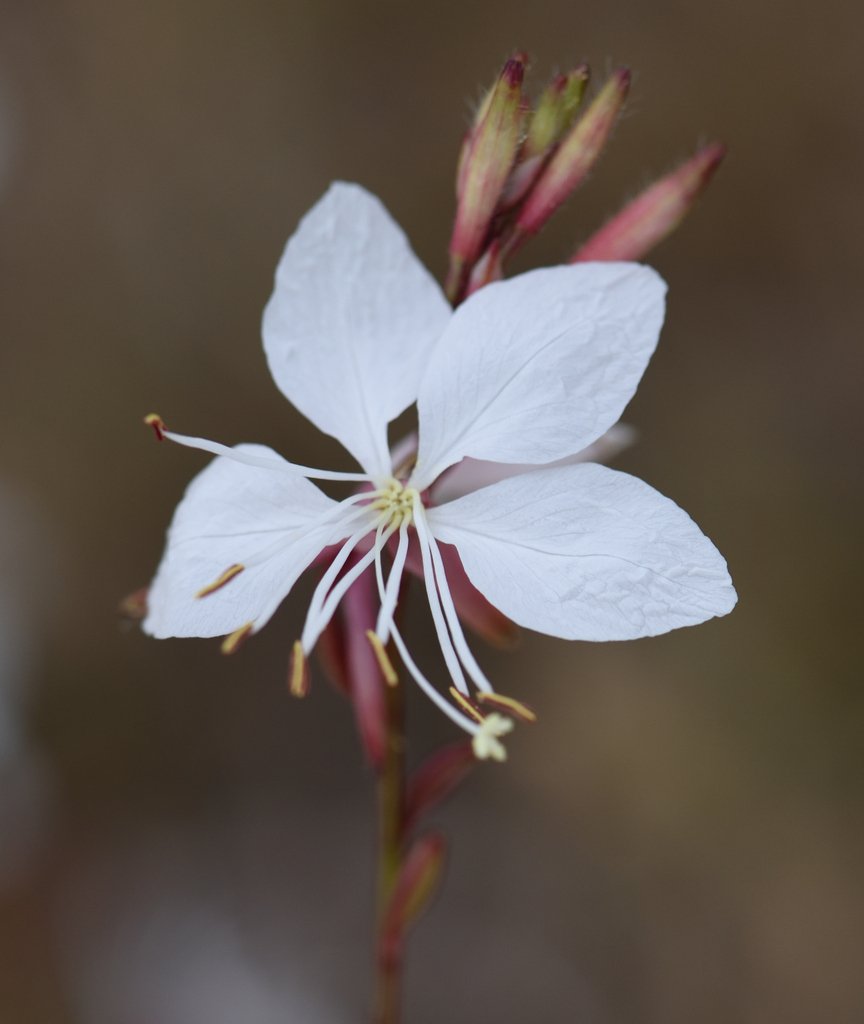


- Botanical name
- Oenothera lindheimeri
- Also known as
- Lindheimer's Beeblossom
- Family
- Onagraceae
- Genus
- Oenothera
- Flowering period
- June to September
- Height
- 60–120 cm
- Spread
- 45–90 cm
- Hardiness
- Hardy in mild areas (RHS H4)
- Reference
- World Flora Online
How to grow Lindheimer's Beeblossom
Full sun
Low once established
Light, free-draining; poor soil is fine
Acid, neutral or alkaline
Planting
Plant in spring, never autumn, so it has a full season to establish before winter. Full sun and light, free-draining soil are essential; it is winter wet rather than cold that kills it. It has a taproot and does not like being moved.
Pruning
Cut back in spring rather than autumn, leaving the top growth on over winter as protection. A trim in midsummer will tidy a plant that has become sprawling and encourage further flowering.
Propagation
Softwood cuttings in late spring or early summer are the most reliable route. Seed germinates readily. Division rarely works well because of the taproot.
Pests and diseases
Few pests. The usual failure is crown or root rot after a wet winter in heavy soil.
Value to wildlife
Bees and hoverflies visit the small flowers, which open in succession over a very long summer season.
Notes
Treat it as short-lived, particularly on clay or in a cold garden, and take a few cuttings each summer as insurance. In heavy soil, a raised bed or a gritty container gives much better results than the open ground.
This guidance was researched and written by GardenDecoded — see our editorial policy for how guides are checked and reviewed.
Other names for this plant
These names have all been used for Oenothera lindheimeri but are no longer the accepted name. You may still meet them on old labels, in books, or in nursery catalogues.
Gaura filiformis var. munzii
Gaura lindheimeri
Others in Oenothera
GardenDecoded is an educational gardening reference. Botanical data comes from World Flora Online and GBIF; growing guidance is our own. Always check a plant's toxicity and local invasiveness status before planting, and never eat or apply a plant based on this site alone.