Lathyrus angulatus
Garden pea
Lathyrus oleraceus
Lam. Species


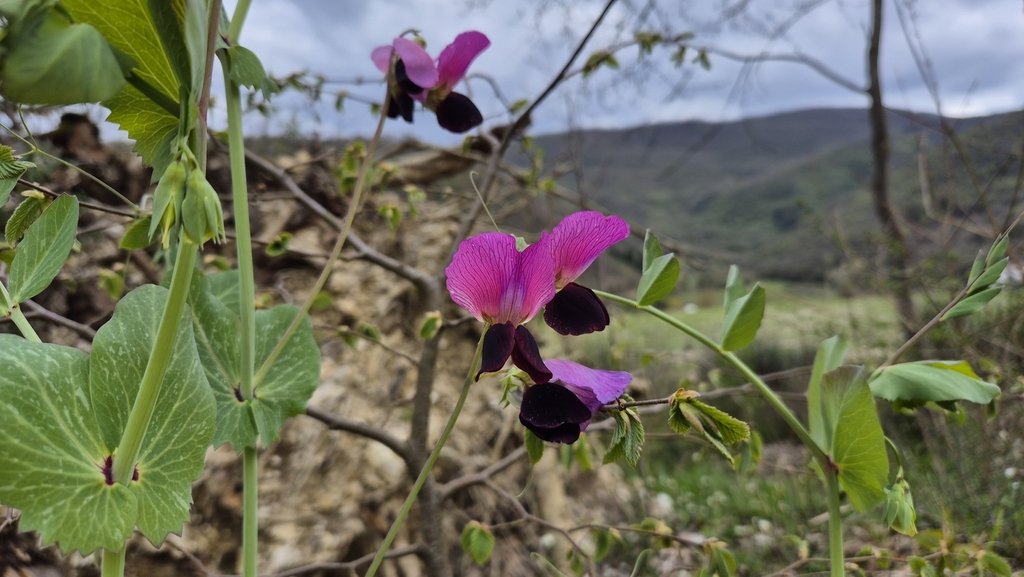
- Botanical name
- Lathyrus oleraceus
- Family
- Fabaceae
- Genus
- Lathyrus
- Flowering period
- May to July
- Height
- 45–180 cm
- Spread
- 20–30 cm
- Reference
- World Flora Online
How to grow Garden pea
Full sun; tolerates light shade
Moderate, increasing markedly once flowering begins
Fertile, moisture-retentive, well-drained
Neutral to slightly alkaline
Planting
Sow from March to June in a flat-bottomed drill about 5 cm deep, spacing seed roughly 8 cm apart in a double row. Peas dislike hot dry weather, so early sowings usually crop better than late ones. Put supports in at sowing time — even short cultivars crop far better with netting or twiggy sticks to climb.
Pruning
Pick pods regularly from the bottom of the plant upwards to keep production going. Cut the top growth off at the end of the season and leave the roots in the ground, as they carry nitrogen-fixing nodules.
Propagation
From seed. Peas are self-pollinating, so saved seed from open-pollinated cultivars comes true.
Pests and diseases
Mice dig up sown seed, which is a common reason for a row failing to appear. Pigeons strip young plants — net them. Pea moth larvae get into the pods of midsummer crops; earlier and later sowings usually escape. Powdery mildew is normal on late crops in dry summers.
Value to wildlife
Bumblebees visit the flowers, though peas set fine without them.
Notes
This is the modern accepted name for the plant long listed as Pisum sativum; seed packets and catalogues still mostly use the old name. Mulch to keep roots cool and moist, which delays mildew and extends cropping.
This guidance was researched and written by GardenDecoded — see our editorial policy for how guides are checked and reviewed.
Other names for this plant
These names have all been used for Lathyrus oleraceus but are no longer the accepted name. You may still meet them on old labels, in books, or in nursery catalogues.
Lathyrus oleraceus subsp. biflorus
Lathyrus oleraceus subsp. oleraceus
Lathyrus oleraceus var. arvense
Lathyrus schaeferi
Pisum abyssinicum
Pisum album
Pisum arvense
Pisum arvense subsp. biflorum
Pisum arvense subsp. humile
Pisum arvense var. abyssinicum
Pisum arvense var. album
Pisum arvense var. humile
Pisum arvense var. leptolobum
Pisum arvense var. quadratum
Pisum arvense var. ramulare
Pisum arvense var. rufum
Pisum arvense var. umbellatum
Pisum arvense var. variegatum
Pisum baclium
Pisum biflorum
Pisum borussicum
Pisum chlorospermum
Pisum coccineum
Pisum coerulescens
Pisum commune
Pisum commune subsp. arvense
Pisum commune subsp. elatius
Pisum commune subsp. sativum
Pisum elatius
Pisum elatius f. album
Pisum elatius subsp. caspicum
Pisum elatius subsp. palestinicum
Pisum elatius var. eriospermum
Pisum elatius var. leiospermum
Pisum elatum
Pisum excorticatum
Pisum fertile
Pisum granulatum
Pisum hortense
Pisum humile
Pisum humile
Pisum jomardi
Pisum leptolobum
Pisum macrocarpum
Pisum macrospermum
Pisum oleraceus var. govorovii
Pisum praecox
Pisum prolificum
Pisum pumilio
Pisum quadratum
Pisum ramulare
Pisum roseum
Pisum rugosum
Pisum saccharatum
Pisum sativum
Pisum sativum f. abyssinicum
Pisum sativum subsp. abyssinicum
Pisum sativum subsp. arvense
Pisum sativum subsp. asiaticum
Pisum sativum subsp. biflorum
Others in Lathyrus
GardenDecoded is an educational gardening reference. Botanical data comes from World Flora Online and GBIF; growing guidance is our own. Always check a plant's toxicity and local invasiveness status before planting, and never eat or apply a plant based on this site alone.