Galanthus × valentinei
Common Snowdrop
Galanthus nivalis
L. Species
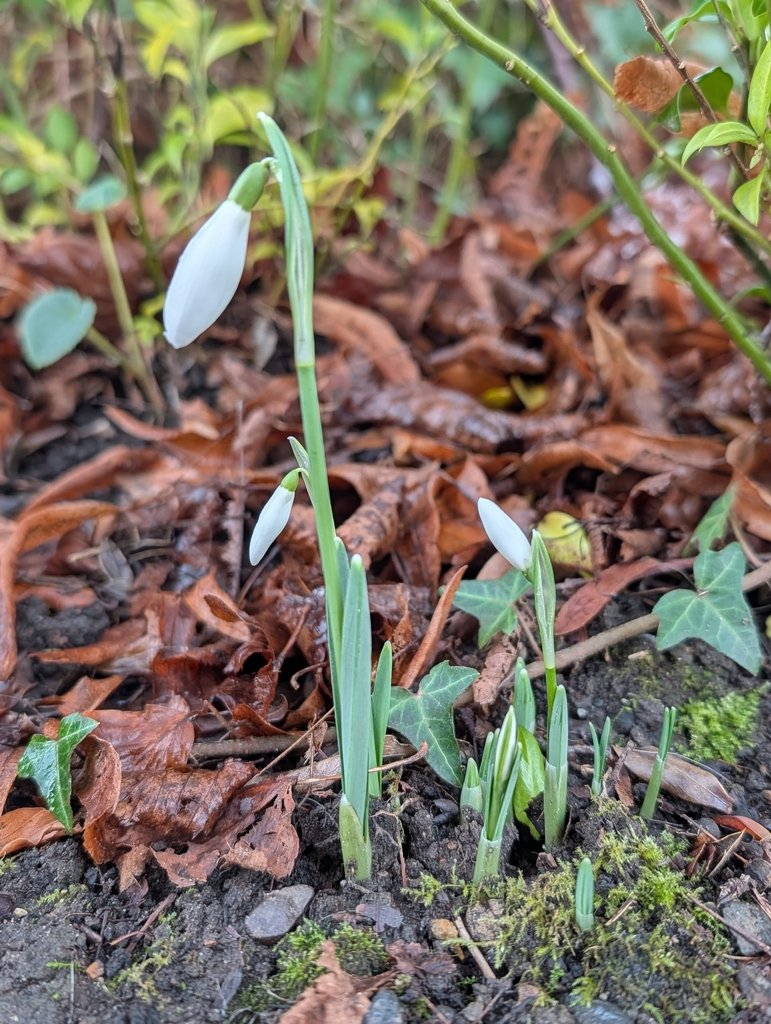


- Botanical name
- Galanthus nivalis
- Also known as
- Bucaneve, Common Snowdrop, Flower of Hope, Milky Snowdrop, Snowdrop
- Family
- Amaryllidaceae
- Genus
- Galanthus
- Flowering period
- January to March
- Height
- 10–15 cm
- Spread
- 5–10 cm
- Hardiness
- Fully hardy (RHS H5)
- Reference
- World Flora Online
How to grow Common Snowdrop
Partial shade to dappled sun
Moderate in growth; tolerates summer dryness once established
Moist, humus-rich, well-drained soil
Neutral to alkaline
Planting
Plant 'in the green' — as growing plants just after flowering in late winter — rather than as dry bulbs in autumn, which establish poorly. Set them about 8 cm deep in dappled shade under deciduous trees or along a hedge bottom, in soil improved with leaf mould.
Pruning
None. Never tie up or cut the leaves; let them yellow and disappear on their own in late spring.
Propagation
Lift and split congested clumps immediately after flowering while still in leaf, teasing them into small groups and replanting at once. This is both the easiest propagation and the cure for a clump that has stopped flowering.
Pests and diseases
Narcissus bulb fly grubs can hollow the bulbs. Grey mould causes collapse of foliage in damp still conditions, and clumps rot in waterlogged ground.
Value to wildlife
One of the earliest nectar sources of the year, worked by bumblebee queens and honeybees on mild winter days. Ants distribute the seed.
Notes
Congested clumps that produce plenty of leaves and no flowers simply need splitting — this is the single most common snowdrop problem. Buy from a nursery rather than a source that may be collecting wild bulbs.
This guidance was researched and written by GardenDecoded — see our editorial policy for how guides are checked and reviewed.
Other names for this plant
These names have all been used for Galanthus nivalis but are no longer the accepted name. You may still meet them on old labels, in books, or in nursery catalogues.
Chianthemum nivale
Galanthus alexandri
Galanthus imperati
Galanthus melvillei
Galanthus montanus
Galanthus nivalis f. pictus
Galanthus nivalis f. platypetalus
Galanthus nivalis f. pleniflorus
Galanthus nivalis subsp. imperati
Galanthus nivalis var. atkinsii
Galanthus nivalis var. carpaticus
Galanthus nivalis var. hololeuca
Galanthus nivalis var. majus
Galanthus nivalis var. minus
Galanthus nivalis var. scharlockii
Galanthus nivalis var. spitzneri
Galanthus scharlockii
Galanthus umbricus
Others in Galanthus
GardenDecoded is an educational gardening reference. Botanical data comes from World Flora Online and GBIF; growing guidance is our own. Always check a plant's toxicity and local invasiveness status before planting, and never eat or apply a plant based on this site alone.